
Activating 30 November 2026
MONITOR (Molecular Assessment and Identification of ctDNA and Optimizing Treatment for HR-Positive, HER2-Negative Metastatic Breast Cancer)
Kevin Kalinsky, MD (Primary Chair)
&
Manali Bhave, MD (Clinical Co-Chair)
&
Azka Ali, MD (TM Co-Chair)
For sites that are members of the SWOG Cancer Research Network ONLY:
If your site is interested in applying to open this study, please complete the feasibility questionnaire. It collects essential information to help us assess each site’s suitability for the study.
View Trial Page at ClinicalTrials.gov
21CTP.Breast01 Study synopsis
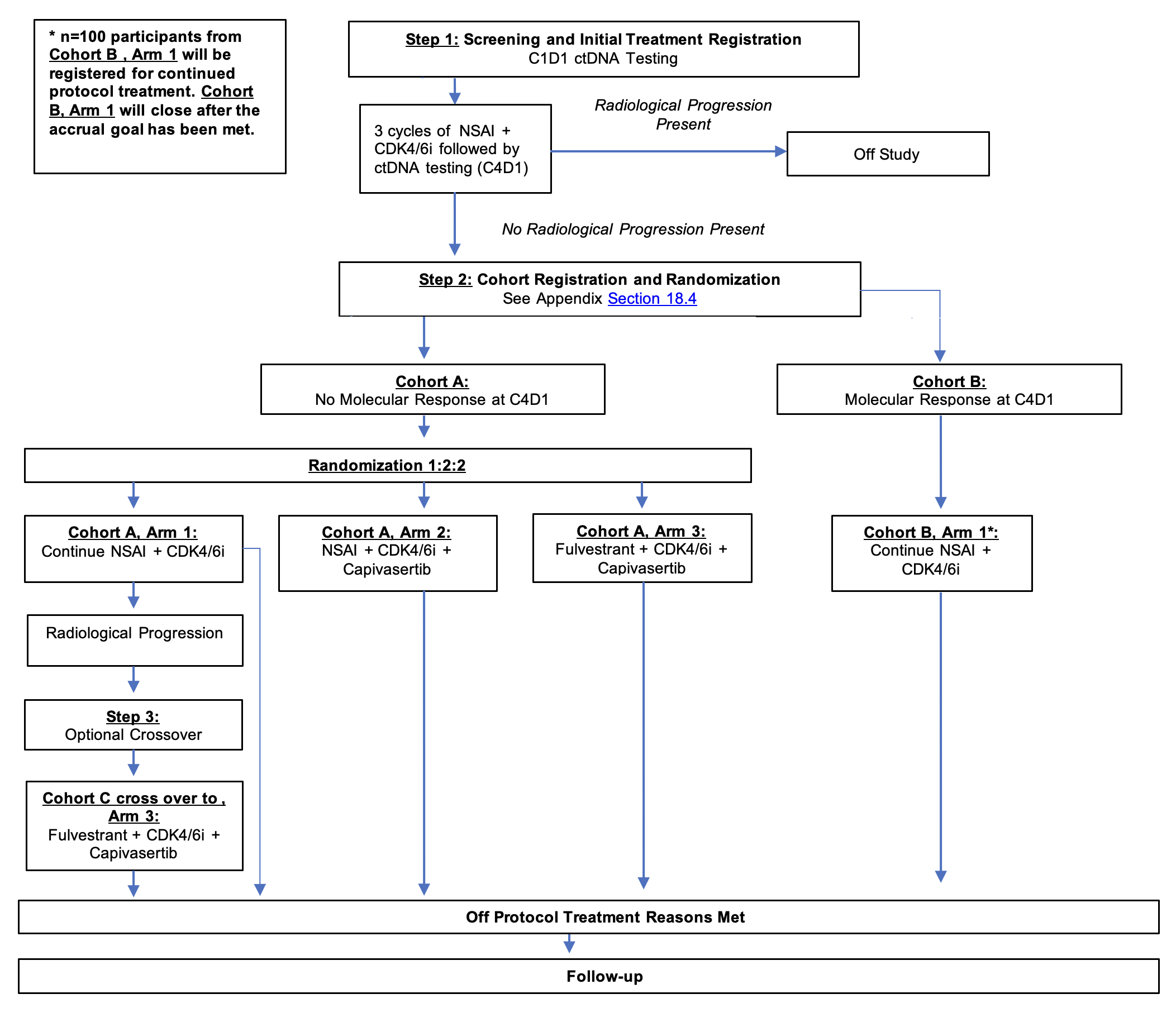
Schema
Objectives
Primary
- a. To evaluate PFS in participants with HR+, HER2- unresectable or metastatic breast cancer with detectable ctDNA at baseline who do not achieve molecular response but show no evidence of progression per RECIST 1.1 after 3 cycles of SOC treatment with non-steroidal aromatase inhibitor (NSAI) + CDK4/6 inhibitor in Arms 2 and 3. PFS will be evaluated separately in participants randomized to NSAI + CDK4/6 inhibitor + capivasertib (Arm 2) and fulvestrant + CDK4/6 inhibitor + capivasertib (Arm 3) and compared to historical control.
Secondary
- a. All Participants: To assess the percentage of participants who achieve molecular response after cycle 3 of SOC treatment and show stable disease or better per RECIST 1.1.
- b. Cohort A: To evaluate the overall survival (OS) for participants on Arms 1, 2, and 3 (separately).
- c. Cohort A: To estimate the clinical benefit rate (CBR) (confirmed or unconfirmed complete or partial response or stable disease ≥ 6 months per RECIST 1.1) separately in Arms 1, 2, and 3 of this participant population from Step 2 Registration.
- d. Cohort A: To estimate the overall response rate (ORR) (confirmed complete and partial responses per RECIST 1.1) separately in Arms 1, 2, and 3 of this participant population, among those with measurable disease at Step 2 Registration.
- e. Cohort A: To estimate the frequency and severity of toxicities in each arm of this participant population.
- f. Cohort A: To explore differences in the following clinical outcomes for participants in Arms 1, 2, and 3: PFS, ORR, and CBR.
- g. Cohort B: To assess PFS in participants who achieve molecular response and show stable disease or better per RECIST 1.1 after three cycles of SOC treatment and then continue SOC treatment with non-steroidal aromatase inhibitor + CDK4/6 inhibitor.
- h. Cohort B: To evaluate the frequency and severity of toxicities in this participant population.
- i. Cohort C: To evaluate PFS2 in participants from Cohort A, Arm 1 who subsequently switch to fulvestrant + CDK4/6 inhibitor + capivasertib after progression on SOC treatment.
- j. Cohort C: To evaluate the frequency and severity of toxicities in this participant population.
Translational Medicine
- a. To bank specimens for future correlative studies.
PRO-CTCAE
- a. To compare the severity and frequency of participant-reported symptoms using selected PRO-CTCAE items (including nausea, vomiting, shortness of breath, rash, diarrhea, fatigue, abdominal pain among Cohort A, Arms 1, 2, and 3; Cohort B, Arm 1; and Cohort C, Arm 3.
Key Eligibility
For Registration Step 1: Screening & Treatment
Inclusion criteria
- Histologically or cytologically confirmed adenocarcinoma of the breast with unresectable or metastatic disease
- Either:
- measurable disease with or without non-measurable disease, OR
- non-measurable disease only, but with bone metastases
- CT or MRI of chest and abdomen AND whole-body bone scan within 28 days prior to registration
- X-rays, scans, or other tests for non-measurable disease within 42 days prior to registration
- HER-negative breast cancer, defined as either:
- negative in situ hybridization test, OR
- IHC status of 0 or 1+
- Most recent biopsy or surgical specimen must be ER+ or PgR+ or both by IHC ≥ 1%
- Females: post-menopausal OR on ovarian ablation with GnRH agonist beginning at least 14 days prior to Cycle 1, Day 1, for duration of study
- Post-menopausal defined by either:
- prior bilateral oophorectomy OR
- age ≥ 60 years OR
- amenorrhea for 12 months after end of hormonal treatments, chemo, ovarian suppression, tamoxifen or similar
- serum estradiol and FSH levels within standard lab reference ranges per local institutional standards
- Post-menopausal defined by either:
- Males: on GnRH agonist beginning at least 14 days prior to Cycle 1, Day 1, for duration of study
- Age 18 years or older
- PS of 0 or 1
- Complete medical history and physical within 28 days prior to registration
- Adequate organ and bone marrow function within 28 days prior to registration
- hemoglobin ≥ 9.0 g/dL
- absolute neutrophil count ≥ 1.5 x 10^3/uL
- platelets ≥ 100 x 10^3/uL
- total bilirubin ≤ 1.5 x institutional ULN (if history of Gilbert’s disease, ≤ 3 x inst ULN)
- ALT/AST ≤ 2.5 x institutional ULN (if liver mets, ≤ 5.0 x inst ULN)
- Calculated creatinine clearance ≥ 50 mL/min per Cockcroft-Gault formula within 28 days prior to registration
- If of reproductive potential (female or male), agrees to use effective contraceptive method
- Agrees to have blood submitted for ctDNA molecular response assessment
Exclusion criteria
- No active CNS disease or leptomeningeal disease
- No endocrine resistance (no breast cancer recurrence within 12 months of end of adjuvant endocrine therapy or adjuvant CDK4/6 inhibitor)
- No initiated or planned NSAI + palbociclib or ribociclib
- No prior systemic therapy (including chemo or hormone tx) for mets
- Prior adjuvant or neoadjuvant anti-cancer agents (including chemo or hormone tx) allowed if appropriate washout period before randomization
- Not on hormone replacement therapy
- No prior fulvestrant or PI3K/AKT inhibitor
- No strong inhibitors or potent inducers or substrates of CYP3A4 or CYP2D6 within 14 days prior to registration (21 days for St. John’s Wort)
- No herbal or natural products meant as treatment or prophylaxis for cancer (participants must agree not to use)
- No radiotherapy within 14 days prior to Step 1 registration
- No major surgical procedure (except for placement of vascular access) or significant traumatic injury within 28 days prior to Step 1 registration
- No anticipated need for major surgery during study
- No unresolved toxicities from prior therapy >CTCAE grade 1 (except alopecia, lymphocyte decrease, grade 2 lymphopenia, or grade 2 chemo-induced neuropathy)
- No uncontrolled diabetes mellitus or risk for hyperglycemia within 28 days prior to registration, as defined by either:
- Type I or Type II diabetes mellitus requiring insulin, OR
-
hemoglobin A1c ≥ 8.0% (63.9 mmol/mol)
- If history of HIV infection, on effective anti-retroviral therapy at registration, with undetectable viral load on most recent test. Well controlled includes all of the following:
-
undetectable viral RNA load
-
CD4+ count > 350
-
no history of AIDS-defining opportunistic infection within past 12 months
-
on anti‑HIV medications for at least 28 days
-
- If history of HCV infection, must have been treated and cured or, if being currently treated, have undetectable HCV viral load on most recent test
- No acute hepatitis B
- If history of chronic HBV infection, on most recent tests must have both:
- negative HBsAg result (unless positive due to recent vaccination)
- HBV DNA viral load < lower limit of quantification
- No GI function impairment or GI disease that may significantly alter absorption of study drugs
- If history of CNS mets or cord compression, clinically stable for at least 28 days since completing definitive treatment, and no systemic steroids
- if brain mets, stable or improved imaging at least 4 weeks after end of definitive treatment
- No prior or concurrent malignancy whose natural history or treatment may interfere with safety or efficacy assessment of study regimen (per treating physician)
- No clinically significant, uncontrolled heart disease and/or cardiac repolarization abnormality, as confirmed by triplicate ECG within 28 days prior to registration (see protocol for details)
- No major bleeding disorder or anticoagulant therapy that would preclude intramuscular administration of agents
- No history of interstitial lung disease (ILD)/pneumonitis that required steroids, and no current ILD/pneumonitis symptoms
- Must not be pregnant or nursing
- negative urine pregnancy test within 14 days prior to registration
For Registration Step 2: Cohort Registration & Randomization
Inclusion criteria
- SWOG SDMC has confirmed participant’s blood specimen is adequate for ctDNA testing
- Participant must be registered within 28 days of receipt of email notification of molecular response assessment
- Stable disease or better per RECIST v1.1 on Registration Step 1 C4D1 assessment
- Baseline ctDNA result indicating “success” and Cycle4, Day 1 result indicating Responder or Non-Responder
- Measurable and non-measurable disease by CT scan or MRI within 28 days prior to Step 2 registration
- Email notification from SDMC indicates either:
- Cohort A: no molecular response
- Cohort B: molecular response
- Participant has met all eligibility criteria for Step 1 registration within 28 days prior to Step 2 registration
For Registration Step 3: Optional Crossover
Inclusion criteria
- Participant has met all eligibility criteria for Step 2 registration within 28 days prior to Step 3 registration
Exclusion criteria
- No prior therapy with fulvestrant or capivasertib
Study Contact Information
Funding Questions:
[email protected]
Protocol Questions Contact:
[email protected]
Medical Questions:
[email protected]
Eligibility and Data Questions:
[email protected]